I realize it is very late in her feast day, but such is life these days for me. I was struck, for what reason I still know not, today by something in the readings for Mass. Mary Magdalene wasn't going to the tomb to see the resurrected Jesus, she was going to finish preparing the body for a proper burial. Since it's late I'll make the point brief - she didn't get it right away either.
We often think of St. Thomas as the doubter, but yet here (albeit obviously earlier) we are shown as if in a caption that nobody really understood what was going on right away. Even after all the time they spent with Jesus they still didn't understand. That is not to condemn the Apostles or any of the disciples in any way - the whole of the reality that Jesus came to fulfill was, and in many ways still is, far beyond the normal imagination of your everyday human. I very often try to tell those in our RCIA program "it's okay - you're not supposed to just understand it right away". Normally we use Peter in the walking on the water episode or Thomas after Jesus appears to the Apostles to illustrate the idea that fides quarens intellectum also requires time, and that's perfectly okay. Now I get to have one more example to add to the list. Yet another example of how the Gospels continue to talk to us in different ways no matter how many times we read them.
Tuesday, July 22, 2008
A late thought on Mary Magdalene
Friday, July 18, 2008
Now that's a pair of lungs
Dr. Paul Camarata of the SaintCast podcast really outdid himself this time. As impressive as it was, I couldn't help but wonder two things: 1) how many times did he have to record it in order to get them all right and 2) how long did he practice to be able to speak that long on one breath? Most impressive.
H/T The Curt Jester.
Monday, June 30, 2008
In honor of the day
I was going to write a snazzy little post on the First Roman Martyrs whom we honor today, but then I read Mike Aquilina's post on the subject. I can't compete, the guy rocks. Instead let me just add this little snip from Our Sunday Visitor's Encyclopedia of Saints
Many martyrs who suffered death under Emperor Nero (r. 54-68) Owing to their executions during the reign of Emperor Nero, they are called Neronian Martyrs, and they are also termed the Protomartyrs of Rome, being honored by the site in Vatican City called the Piazza of the Protomartyrs. These early Christians were disciples of the Apostles, and they endured hideous tortures and ghastly deaths following the burning of Rome in the infamous fire of 62. Their dignity in suffering, and their fervor to the end, did not provide Nero or the Romans with the public diversion desired. Instead, the faith was firmly planted in the Eternal City.
I just love how that was worded. It is examples like this that give me a little hope. If they can withstand what was asked of them maybe, just maybe, I can withstand the little cross I have to bear if only I can find a way to cooperate with the grace offered me.
Monday, April 28, 2008
Varia
More Papal pictures from St. Joseph's Seminary in Dunwoodie, courtesy of Keith (again). It's still hard to believe the Pope was here just such a short time ago.
Being the optional memorial of St. Louis Marie de Montfort and conveniently exactly 33 days from the Marian feast of the Visitation, today is a perfect day to start the preparation for the Consecration to Jesus through Mary. At least, that's what I'm doing. I owe a huge debt of gratitude to the layout done by the folks at Fish Eaters and also the Friends of Our Lady for providing an up-to-date schedule to confirm for me that today was the appropriate day to start. Reading de Montfort's True Devotion has already been an incredible experience - it could very well have been written in the present day. Pray, pray, pray.
Friday, February 22, 2008
Feast of the Chair of St. Peter
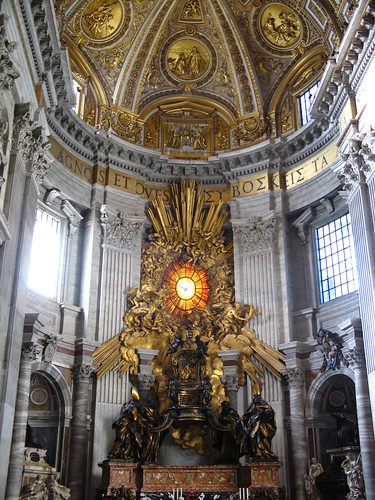
There are a veritable plethora of resources to which I could point you, dear reader, regarding the importance of the office (and hence the chair - think of it as representative of the office) of Peter and his successors. If you don't know them already first look at these Bible verses, then hit up some of the deeper Catholic resources. Catholic Answers is a great resource, as are Catholic-Pages and Catholic Culture. But let's move on to those Bible verses:
First, Luke 22:31-32:
"Simon, Simon, behold Satan has demanded to sift all of you like wheat, but I have prayed that your own faith may not fail; and once you have turned back, you must strengthen your brothers."There are further examples of Peter having the lead in the company of the Apostles:
- In Matthew 16:16 we see Peter correctly identify Jesus as "the Christ, the Son of the living God", leading to the statement of Jesus with which I started this post. Jesus' reply is extraordinarily telling: "Blessed are you, Simon son of Jonah. For flesh and blood has not revealed this to you, but my heavenly Father." Peter has been confirmed by the Father for a special mission.
- In Acts 1:15 and following we find Peter taking the lead of the Apostles in the appointment of Matthias, the successor to Judas. This is a perfect example of the role of the Pope - to strengthen and to lead; Peter calls for the appointment, the Church prays and acts as one.
- In Acts 2 we have Pentecost. Indeed, the tongues of fire came to rest on "all of them", but in Acts 2:14-40 we see Peter is the one who speaks for the Apostles giving what could be called the first homily.
Image source.
Thursday, February 14, 2008
Sister Lucia investigation begins
Just as we've all been hearing about how Pope Benedict has been slowing down the process for beatification and canonization, VIS tells us:
"This evening in the cathedral of Coimbra, Portugal, Cardinal Jose Saraiva Martins C.M.F., president of the Congregation for the Causes of Saints, presided at a Mass marking the third anniversary of the death of Sister Lucia dos Santos. Following the ceremony he announced that the Holy Father Benedict XVI, benevolently accepting a request presented by Bishop Albino Mamede Cleto of Coimbra and shared by many bishops and faithful throughout the world, has waived the five-year waiting period established by canonical norms (art. 9 of "Normae servandae") and granted that, just three years after the death of Sister Lucia (known to the world as one of the three seers of Fatima), the diocesan stage of the cause for her beatification may begin".I have to admit, I'm not exactly upset over this at all. I do think the normal five-year waiting period is a very good idea, but there are cases where it may not be necessary. Further, it's not like we'll be going from this opening to canonization in a short time - just the diocesan stage can take years. Fatima, I think, still has a particular role to play in the coming years. Our Lady of Fatima, pray for us!
Friday, December 07, 2007
Saint Ambrose
I know I should have had this post up earlier today, but this has just been one of those days. If nothing else, it's not that late yet on the West Coast. That said, I wanted to make sure I didn't rush this any more than necessary since I'm also taking this opportunity to note that Saint Ambrose is as of now officially the patron Saint of this blog. I'm sure it could be said that his assistance could have been useful a long time ago. But enough about this blog. Saint Ambrose is certainly most well-known as the Bishop who most helped to convert Saint Augustine, following all the way to his baptism by Ambrose. Perhaps my favorite quote from Augustine about Ambrose is how he mentions his astonishment that Ambrose would read the Scriptures without moving his lips. To us it seems strange, but to him a revelation. Ambrose, however, was far more than just a bookworm.
His father having died while he was young, Ambrose's mother returned to Rome to raise her family. The young Ambrose, named after his father, learned Greek and became a notable poet and orator. He was named Assessor by the praetorian prefect Anicius Probus and then the emperor Valentian made him governor of Liguria and Aemilia. For this post he took up residence in Milan.
It was during this time that the Arian bishop of Milan, Auxentius, died. As episcopal appointments were directed by popular acclaim at this point in history there was much strife between the Arian and Catholic parties. When Ambrose went to the church to plead for calm and for the choice to be made in a spirit of peace without tumult a voice cried out 'Ambrose, bishop!' The cry was quickly echoed through the assembly, stunning Ambrose who was still only a catechumen. The decision was relayed to the emperor with Ambrose pleading to be excused; Valentian considered it a great honor that his appointed governor should be seen fit for episcopal office and ordered that the election take place. Ambrose went so far as to attempt to hide in the house of a senator, but when word arrived of the emperor's decision Ambrose was handed over and received episcopal consecration a week later - today, December 7, 374. We celebrate thus, not his birth into Heaven but his ordination to the episcopacy.
Ambrose set himself to deep study, feeling himself ignorant of theology. He was known for always being available to anyone who needed him and for his strict simplicity. Ambrose had affection for the vocation of consecrated virgins and, at the request of his sister St. Marcellina he collected his sermons on this subject thereby making a famous treatise. So effective were his sermons that mothers tried to keep their daughters away - so effective in fact he was charged with attempting to depopulate the empire. His response? Wars, not maidens, are the destroyers of the human race.
The statesman Symmachus attempted to have the altar of the ancient goddess of Victory re-established in the senate-house. In his request to Valentian he made suggestions which would seem eerily similar to those we hear today, including: "What does it matter the way in which each seeks for truth? Ther emust be more than one road to the great mystery." Wikipedia describes Ambrose's response thus:
To this petition Ambrose replied in a letter to Valentinian, arguing that the devoted worshipers of idols had often been forsaken by their deities; that the native valour of the Roman soldiers had gained their victories, and not the pretended influence of pagan priests; that these idolatrous worshipers requested for themselves what they refused to Christians; that voluntary was more honourable than constrained virginity; that as the Christian ministers declined to receive temporal emoluments, they should also be denied to pagan priests; that it was absurd to suppose that God would inflict a famine upon the empire for neglecting to support a religious system contrary to His will as revealed in the Holy Scriptures; that the whole process of nature encouraged innovations, and that all nations had permitted them even in religion; that heathen sacrifices were offensive to Christians; and that it was the duty of a Christian prince to suppress pagan ceremonies.In further conflicts with the Arian Empress Justina Ambrose wielded the office of Bishop with both great bravado and great effect. When ordered to hand over churches for Arian worship he refused, and after preaching on Palm Sunday against handing over churches the people barricaded themselves in the basilica with their pastor as troops approached, intending to starve them out. As they waited, Ambrose taught the people Psalms and hymns of his own hand. Finally, when asked to appoint lay judges to decide his case Ambrose reminded Valentian that laymen could not judge bishops or make ecclesiastical laws. It was at this time he ascended his cathedra and in explaining the situation uttered the memorable phrase, "the emperor is in the Church, not over it."
In these always exciting times, Ambrose was never too long to find conflict coming his way. There was a case where he defended a bishop from having to pay restitution to rebuild a Jewish temple which had been torn down, suggesting that a bishop should never be constrained to pay for the erection of a temple to be used for false worship. Modern sensibilities may find this rather unsettling, but times then were far more polemical than they are now or rather than we would like to think they are now.
After a brutal massacre at the order of the emperor Theodosius Ambrose declared him excommunicated until he properly repented and made proper penance. Even though the massacre was well-known at the time it is related that Theodosius removed every sign of royalty and publicly begged forgiveness. In this we see an interesting foreshadowing of St. Thomas Beckett and Henry II, although this did not end in further bloodshed.
We read of his last days:
When he fell sick he foretold his death, but said he should live till Easter. On the day of his death he lay with his hands extended in the form of a cross for several hours, moving his lips in constnt prayer. St. Honoratus of Vercelli was there, resting in another room, when he seemed to hear a voice crying three times to him, 'Arise Make haste! He is going'. He went down and gave him the Body of the Lord, and soon after St. Ambrose was dead. It was Good Friday, April 4, 397, and he was about fifty-seven years old. He was buried on Easter day, and his relics rest under the high altar of the basilica, where they were buried in 835.
St. Ambrose was declared a Doctor of the Church in 1298 by Pope Boniface VIII, making him one of the four Great Doctors of the Western Church. He is the patron saint of, inter alia, learning, students, schoolchildren and Milan, Italy. He is also the patron saint of bees and beekeepers owing to his appellation of "The Honey Tongued Doctor". There is indeed much the modern Church can learn from this ancient Father.
---
Most of the above information is taken from Butler's Lives of the Saints
, except where otherwise noted. I have also spliced in other information which does not appear in Butler's work.Tuesday, November 20, 2007
An interesting idea
Fr. Tim Finigan of The Hermeneutic of Continuity has a very intriguing proposal:
So the campaign starts here. Someone reading this blog must know someone who knows Mel Gibson. 1. Encourage him to read Evelyn Waugh's stirring account of St Edmund Campion (if indeed he has not already read it); 2. Challenge him to find a good reason not to make a thrilling, spectacular and emotionally-charged blockbuster movie about the Saint which would inspire anyone with an open mind; 3. Emphasise that this will counter the black legend, whig history propaganda of "Elizabeth. The Golden Age".I'm certain there are viewpoints all over the map about Mel Gibson and I'm not intending to side with any of them. This is a very interesting idea indeed, and it may well be that Gibson is the only person in Hollywood who would have both interest in this project and the ability to see it through. I think the good Saint would smile indeed on a project to help those oppressed and persecuted by the wrong-headed on account of their faith.
Sunday, November 18, 2007
Getting it
In the latest of her multi-directional missives, Amy gets to the real heart of the issue in her conclusion:
Saints are those who get this: who understand that they are loved, treasured and forgiven by God, but who are not satisfied with where they are either, who are willing to look, every day at their lives and choices, and go deeper and deeper, towards more and more freedom and more radical love of God and those whom God loves - which is, you know, everyone.Saints are restless. They don’t sit still. They are not complacent and self-satisfied, assuring themselves that it’s all really complex and they’re doing their best, after all. What more does God want from me, anyway?
What must I do to inherit eternal life?
It is complex. And we do think we are doing our best. I ask, however - so what? Jesus did not tell us to analyze the complexities of the moral issues or reassure ourselves of our good intentions. He told us that "You, therefore, must be perfect as your heavenly Father is perfect" (Mt 5:48).
Thursday, January 25, 2007
Feast of the Conversion of Saint Paul
From the reading of Morning Prayer in the Liturgy of the Hours:

I have appeared to you to designate you as my servant and as a witness to what you have seen of me and what you will see of me. I have delivered you from this people and from the nations, to open the eyes of those to whom I am sending you, to turn them from darkness to light and from the dominion of Satan to God; that through their faith in me they may obtain the forgiveness of their sins and a portion among God's people. (Acts 26:16b-18)What a call! What a weight! And yet, St. Paul turns on his spiritual heel and begins to follow this commission that has since probably seen no equal. This, to me, approaches equivalent weight to "Saul, Saul, why do you persecute me?" It's also a microcosm of conversion in any case - first you are informed, then you are converted. Sometimes it's instantaneous, sometimes the lag between step 1 and step 2 is well nigh to forever. St. Paul, pray for us!
(Image from catholicculture.org.)
Fr. Z outdoes me by a long shot with his patristiblogging of Paul's conversion.